
From pasta sheets to the freezer: everything about stuffed pasta
At miscusi, stuffed pasta has two faces: cacio e pepe plin ravioli and pansoti al Nocino. The first are a Piedmontese shape pinched closed—the plin—with a Roman recipe inside. The second are Ligurian through and through. For us, this is the pasta that needs extra care, in the kitchen and afterwards, whether you order takeaway or delivery.
Fresh stuffed pasta consists of a sheet of fresh pasta wrapped around a filling of meat, cheese, vegetables or fish. Italian law treats it first and foremost as fresh pasta: Presidential Decree 187/2001 requires prepacked fresh pasta to contain at least 24% moisture and to be kept at no more than 4°C, with a 2°C tolerance DPR 187/2001 [1]. Stuffed pasta has no legal category of its own. At home, keep it between 0 and 4°C and eat it by its use-by date; if homemade, eat it within a couple of days. In the freezer at −18°C, it lasts for months and can be cooked without thawing.
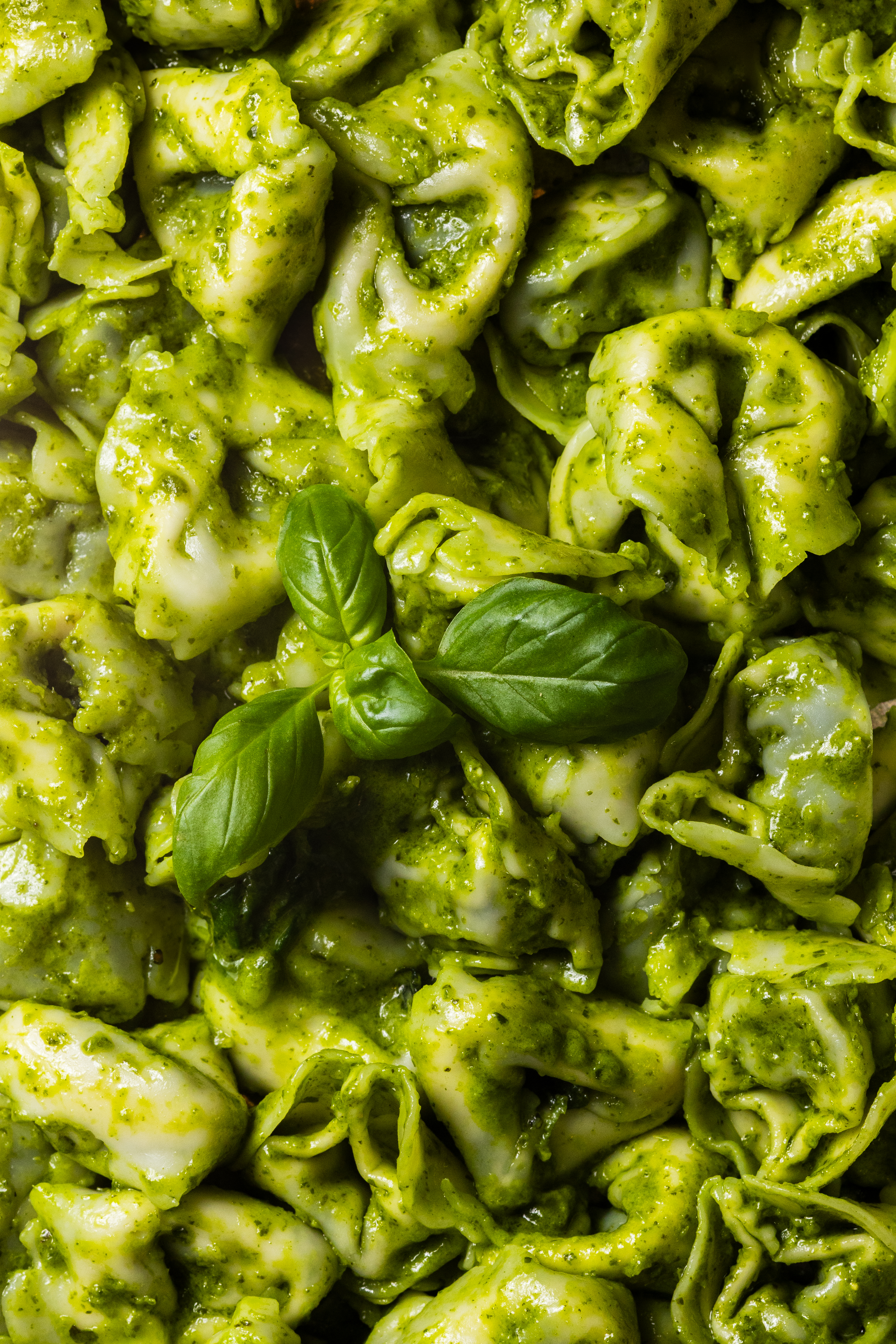
The filling for Bologna tortellini has been recorded in a notarial deed since 1974. Few dishes in the world have a notary behind them.
What Italian law says about fresh stuffed pasta
It's fresh pasta, so fresh-pasta rules apply. The law never actually uses the word 'stuffed'.
Italy's Presidential Decree 187 of 9 February 2001 distinguishes dried pasta from fresh pasta and sets precise requirements for the latter in Article 9 DPR 187/2001 [1]:
| 1. Unpackaged fresh pasta must be kept at no more than 4°C from production to sale, with a tolerance of 3°C during transport and 2°C otherwise. |
| 2. Prepacked fresh pasta must contain at least 24% moisture, have a water activity (the freely available water microorganisms can use) between 0.92 and 0.97, and undergo heat treatment at least equivalent to pasteurisation. It must also remain in the cold chain. |
| 3. Stabilised pasta contains at least 20% moisture and has a water activity no higher than 0.92, with treatments allowing it to be transported and kept at room temperature. |
Egg pasta gets its own article, number 8: it must be made with semolina and at least four whole hen's eggs per kilogram, equivalent to at least 200 g of egg DPR 187/2001 [2]. Stuffed pasta, usually made with eggs, falls within these rules without a separate legal definition. When other ingredients are added to the dough, Article 7 deals with 'special pasta' DPR 187/2001 [3].
Here's a detail that busts a common myth: the original decree imposed a five-day maximum shelf life on unpackaged fresh pasta. That limit was removed in 2002 by Law 39, which adapted Italian rules to EU legislation. Today it's the cold chain that matters. For once, lawmakers took a rule away rather than adding one.
Types of fresh stuffed pasta: Italy on a platter
Every region has its shape and almost every town its filling. Only two varieties, though, have EU Protected Geographical Indication (PGI) status.
| Shape | Region | Typical filling | Worth knowing |
|---|---|---|---|
| Tortellini | Emilia-Romagna, Bologna | Pork loin, prosciutto, mortadella, Parmigiano Reggiano, egg, nutmeg | Recipe officially registered by the Dotta Confraternita del Tortellino in 1974 |
| Cappellacci di zucca ferraresi | Emilia-Romagna, Ferrara | Violina pumpkin | PGI since 2016; pasta sheet 0.4–0.7 mm thick |
| Culurgionis d'Ogliastra | Sardinia | Potatoes, cheese, mint or garlic or basil | PGI since 2016; egg-free dough and braided wheat-ear seal |
| Agnolotti and plin | Piedmont | Usually roast meat | Traditional Piedmontese products |
| Pansoti | Liguria | Wild greens known as preboggion, ricotta and cheese | Served with walnut sauce |
| Casoncelli | Lombardy, Bergamo | Usually meat, bread and cheese | Traditional Bergamo speciality |
| Anolini and cappelletti | Emilia-Romagna | Cheese and meat, depending on the area | Traditional Emilia-Romagna products |
| Cjalzòns | Friuli Venezia Giulia | A sweet-and-savoury mixture that varies from valley to valley | Traditional Friulian speciality |
The table draws on the Tortellino Brotherhood [4] for the Bolognese recipe, the European geographical-indication register for Culurgionis [5], the Cappellacci specification [6], the Italian Ministry of Agriculture's traditional-food list [7] and the Ligurian Chamber of Commerce for pansoti [8]. The Ministry's list covers foods prepared the same way for at least 25 years, without the requirements of a formal product specification.
The tortellini recipe is worth remembering: it makes roughly a thousand pieces and calls for 450 g of Parmigiano. Apparently nobody in Bologna ever planned a dinner for two.
Eggs or semolina and water: what changes in the dough?
Eggs give the dough elasticity and strength, which is why most stuffed pasta uses them. But egg-free sheets exist too, as with culurgiones.
In fresh egg pasta, egg-white proteins create a network holding the dough together during cooking. Researchers Alamprese, Casiraghi and Rossi from the University of Milan found this when making fresh pasta with eggs from hens of different ages. Eggs from older hens had proportionally less white relative to yolk; the network was weaker and more solids leached into the cooking water Alamprese 2011 [9]. In other words, egg is the glue in the pasta sheet, which has to hold a moist filling without bursting.
Culurgiones take another approach: their specification requires semolina and flour, lard, water and salt, with no egg; the pasta is sealed by hand with at least ten wheat-ear-shaped folds. Our pansoti, meanwhile, use organic soft-wheat flour and durum-wheat semolina, plus Italian barn-laid eggs. In Sardinia, then, they leave the eggs to the hens; we don't. Two schools, two delicious results.
How to store fresh stuffed pasta
Keep it refrigerated at 0–4°C and follow the date printed on the package. Homemade pasta should be eaten within a couple of days or frozen straight away.
Shelf life depends on packaging. A research group at the University of Sassari tested pasteurised fresh cheese-filled pasta, packed either in a protective atmosphere (nitrogen and carbon dioxide instead of air) or in normal air, and stored it at 4°C for six weeks. The protective-atmosphere pasta stayed free of mould for 42 days; the air-packed product spoiled between days seven and fourteen Sanguinetti 2011 [10]. This was one specific industrial product, but there's a lesson for home, too: once you open the pack, the countdown speeds up.
In the fridge
The UK's Food Standards Agency recommends keeping a home fridge between 0 and 5°C FSA [11]; Italian rules for fresh pasta specify 4°C. Homemade stuffed pasta is more delicate because it hasn't been pasteurised or professionally packed: spread it on a floured tray, cover it and eat it within a couple of days. Moist fillings such as ricotta, meat or fish are usually the first parts to spoil.
Don't leave it outside the fridge for long: the US Department of Agriculture's food-safety service advises discarding fresh pasta that has spent over two hours above 4°C USDA FSIS [12].
Another thing to know is Listeria, a bacterium that can multiply even at refrigerator temperatures. That's why the European Food Safety Authority recommends keeping fridges properly cold EFSA [13]. Italy's National Institute of Health identifies older adults, pregnant women, newborns and immunocompromised people as particularly vulnerable ISS [14]. For them, expiry dates must be followed strictly.
In the freezer
At −18°C stuffed pasta keeps for months. The FSA says food can be frozen up to the use-by date on its pack FSA [11]. Freezing stops bacteria growing but doesn't kill them, so freeze pasta as soon as you buy or make it.
At home, the best method is to separate the pieces: space them out on a floured tray, freeze until solid, and only then transfer them to a bag. They won't stick together and you can take out exactly what you need. Drop them straight into boiling water while still frozen: if thawed in the fridge, the pasta sheet absorbs moisture and can break apart.
Homemade fresh stuffed pasta: a basic recipe
All you need is a thin egg-pasta sheet, a fairly dry filling and as little trapped air as possible. Fillings vary, but the method stays the same.
| 1. The dough: the classic ratio is one egg per 100 g of flour; for four people, that's 400 g of flour and four eggs. Knead until smooth, let it rest covered for half an hour, then roll thin. The specification for Ferrara's cappellacci calls for 0.4–0.7 mm, almost transparent. |
| 2. The filling: the simplest is ricotta and spinach, with the cooked spinach thoroughly squeezed dry. Water is the enemy of a good seal. Add Parmigiano, salt and nutmeg, and keep the mixture firm. |
| 3. The seal: place a small dab of filling on the sheet, fold or cover it, and press around the edges with your fingers to push out the air. An air bubble inside means pasta that can burst in the pan. |
| 4. Cooking: cook in plenty of salted water at a lively but controlled boil for just a few minutes. Check the edge: it should be tender yet still hold its shape. |
If rolling pasta by hand sounds a bit daunting, come to one of our pasta-making events. We knead and shape it together, then eat what we've made. Mistakes are still possible. At least you'll be tasting them with good company.
Sauces for fresh stuffed pasta
The richer the filling, the lighter the sauce should be. That's our rule, and tradition agrees.
Bolognese tortellini belong in broth; Ligurian pansoti come with walnut sauce; many pumpkin or cheese-and-greens pastas need only butter and sage. The sauce should support the filling: piling a heavy meat ragù onto meat-filled pasta is repetition, not a dish. If the filling already does it all, the sauce only needs to keep it company.
How much does fresh stuffed pasta cost?
There are no official reference prices, and the cost varies widely with the filling and the work involved.
The Italian Ministry of Enterprises' price observatory tracks everyday consumer goods each month, but not fresh or stuffed pasta MIMIT [15]. We found no other public price series. What drives the price up is easy to see: the proportion and type of filling (meat and fish usually cost more than vegetables), eggs, hand-folding and geographical-indication certification. At the counter, always ask for the price per kilogram: pack weights differ and visual comparisons can mislead. The most expensive pasta, after all, is the packet you buy and then forget at the back of the fridge.
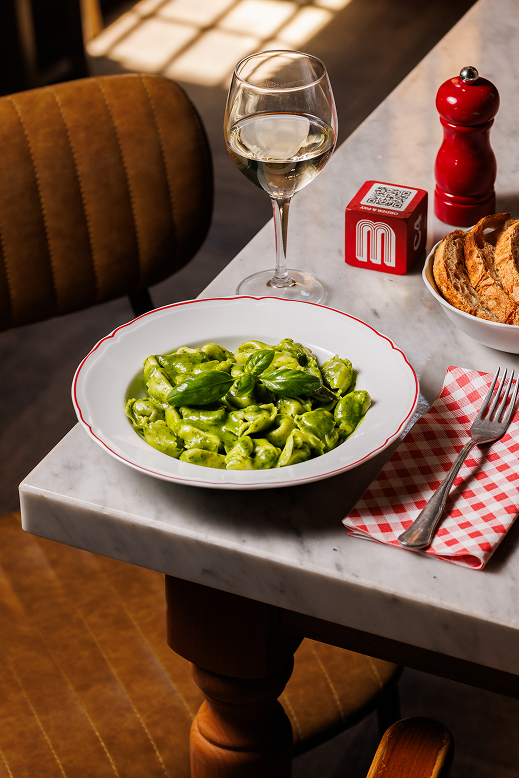
At miscusi, we seal every piece with care
If you've read this far, you wanted to know what fresh stuffed pasta is and how to look after it. The answer comes down to two words: cold and speed. Keep it cold until you cook it; don't wait too long to eat it.
We serve it ready to enjoy: cacio e pepe plin ravioli, small pasta parcels with a cacio e pepe sauce inside, and pansoti al Nocino, filled with ricotta, spinach and Grana Padano PDO, topped with walnut pesto. Alongside them is our Superpasta, fresh pasta made with water and organic semolina: Kronos durum wheat and stone-ground ancient grains such as Perciasacchi.
Choose from our menu or go make your own with your favourite shapes and sauces. At miscusi, just about anyone can eat well, even those who have never rolled a pasta sheet at home and don't plan to start. Book a table: for one evening, storage is our problem.
Quick answers (FAQ)
How long does fresh stuffed pasta keep in the fridge?
Packaged pasta keeps until the stated use-by date if the pack stays closed and it remains between 0 and 4°C. Once opened, eat it promptly. Homemade pasta is best eaten within a couple of days or frozen straight away.
Can you freeze fresh stuffed pasta?
Yes, it keeps for months at −18°C. Freeze individual pieces separately on a tray before transferring them to a bag so they don't stick. Freezing stops bacteria growing without eliminating them, so freeze pasta while it's still fresh.
How do you cook frozen stuffed pasta?
Put it straight into boiling water without thawing. Allow an extra minute or two compared with fresh pasta. Thawing in the fridge can make the dough damp and more likely to split during cooking.
Is fish-filled fresh pasta stored the same way?
Yes, but take extra care: fish is particularly perishable. Homemade fish-filled pasta should be cooked on the same day or frozen immediately, and kept in the coldest part of the fridge.
What's the difference between fresh and stabilised pasta?
Fresh pasta must be kept chilled at no more than 4°C. Stabilised pasta has less freely available water and undergoes a treatment that allows it to stay on the shelf at room temperature. The rules are set by DPR 187/2001.
What are the best-known kinds of fresh stuffed pasta?
Tortellini, cappelletti and anolini in Emilia-Romagna; agnolotti and plin in Piedmont; casoncelli in Lombardy; pansoti in Liguria; culurgiones in Sardinia; and cjalzòns in Friuli. Only two have PGI status: Cappellacci di zucca ferraresi and Culurgionis d'Ogliastra.
Sources
| 1. Italian Presidential Decree 187/2001, regulation on the production and sale of flour products and pasta, Article 9, Normattiva. https://www.normattiva.it/uri-res/N2Ls?urn:nir:stato:decreto.presidente.repubblica:2001-02-09;187~art9 |
| 2. Italian Presidential Decree 187/2001, Article 8, Normattiva. https://www.normattiva.it/uri-res/N2Ls?urn:nir:stato:decreto.presidente.repubblica:2001-02-09;187~art8 |
| 3. Italian Presidential Decree 187/2001, current text, Article 7, FAOLEX. https://faolex.fao.org/docs/pdf/ita31873.pdf |
| 4. Dotta Confraternita del Tortellino, The registered recipe. https://www.confraternitadeltortellino.it/la-ricetta-depositata/ |
| 5. European Commission, eAmbrosia, Culurgionis d'Ogliastra PGI, Implementing Regulation (EU) 2016/1729. https://webgate.ec.europa.eu/eambrosia-api/api/v1/geographical-indications/EUGI00000015912 |
| 6. Italian Ministry of Agriculture, Production specification for Cappellacci di zucca ferraresi PGI. https://www.masaf.gov.it/flex/cm/pages/ServeBLOB.php/L/IT/IDPagina/3348 |
| 7. Italian Ministry of Agriculture, National list of traditional agri-food products, 25th revision. https://www.masaf.gov.it/flex/cm/pages/ServeBLOB.php/L/IT/IDPagina/22781 |
| 8. Chamber of Commerce of the Ligurian Riviera, Liguria Gourmet list, 2015. https://www.rivlig.camcom.gov.it/sites/default/files/contenuto_redazione/oldsite/iniziativePromozionali/91/9158_CCIAASV_2272015.pdf |
| 9. Alamprese C, Casiraghi E, Rossi M, Effects of housing system and age of laying hens on egg performance in fresh pasta production: pasta cooking behaviour, Journal of the Science of Food and Agriculture, 2011. https://europepmc.org/article/MED/21384359 |
| 10. Sanguinetti AM et al., Quality changes of fresh filled pasta during storage: influence of modified atmosphere packaging on microbial growth and sensory properties, Food Science and Technology International, 2011. https://europepmc.org/article/MED/21364042 |
| 11. Food Standards Agency, How to chill, freeze and defrost food safely. https://www.gov.uk/government/publications/how-to-chill-freeze-and-defrost-food-safely/how-to-chill-freeze-and-defrost-food-safely |
| 12. USDA Food Safety and Inspection Service, safe food storage guidance. https://www.govinfo.gov/content/pkg/GOVPUB-A110-PURL-gpo140676/pdf/GOVPUB-A110-PURL-gpo140676.pdf |
| 13. EFSA, Listeria. https://www.efsa.europa.eu/it/topics/topic/listeria |
| 14. Italian National Institute of Health, EpiCentro, Listeriosis. https://www.epicentro.iss.it/listeria/ |
| 15. Italian Ministry of Enterprises, Consumer price observatory, everyday goods and services. https://osservaprezzi.mise.gov.it/prezzi/livelli/beni-e-servizi-di-largo-consumo/archivio-rilevazioni-beni-e-servizi-di-largo-consumo |