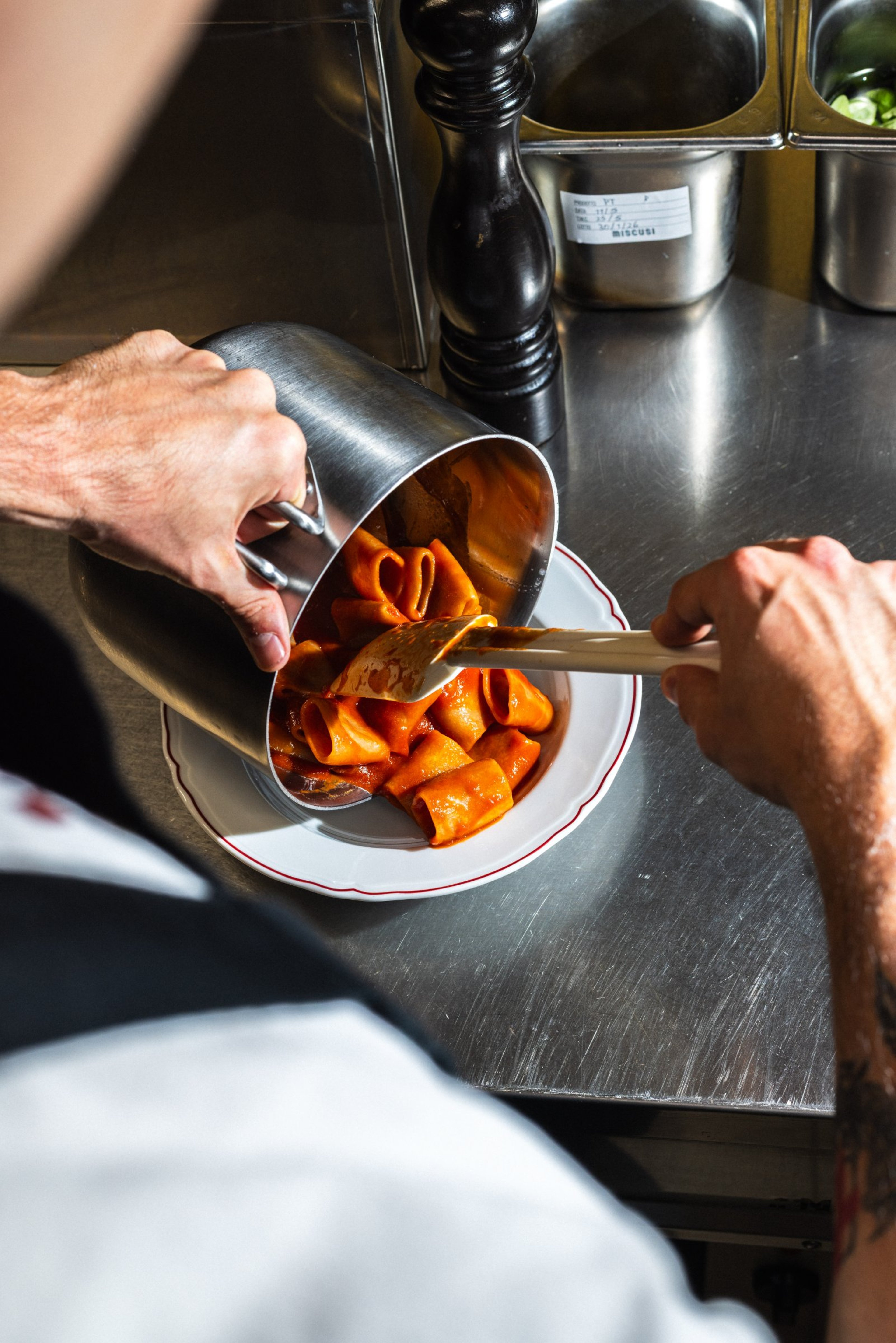
Serving format, refrigerated storage, and what actually moves the glycemic curve
Among Italy's staple starches, pasta raises blood glucose the least. Semolina pasta GI runs 47 (spaghetti) to 63 (short shapes), category mean ~52. White bread 75, boiled rice 73, boiled potatoes 78. What really moves the number: shape, cooking, and what you pair it with — not wholemeal flour as much as you think.
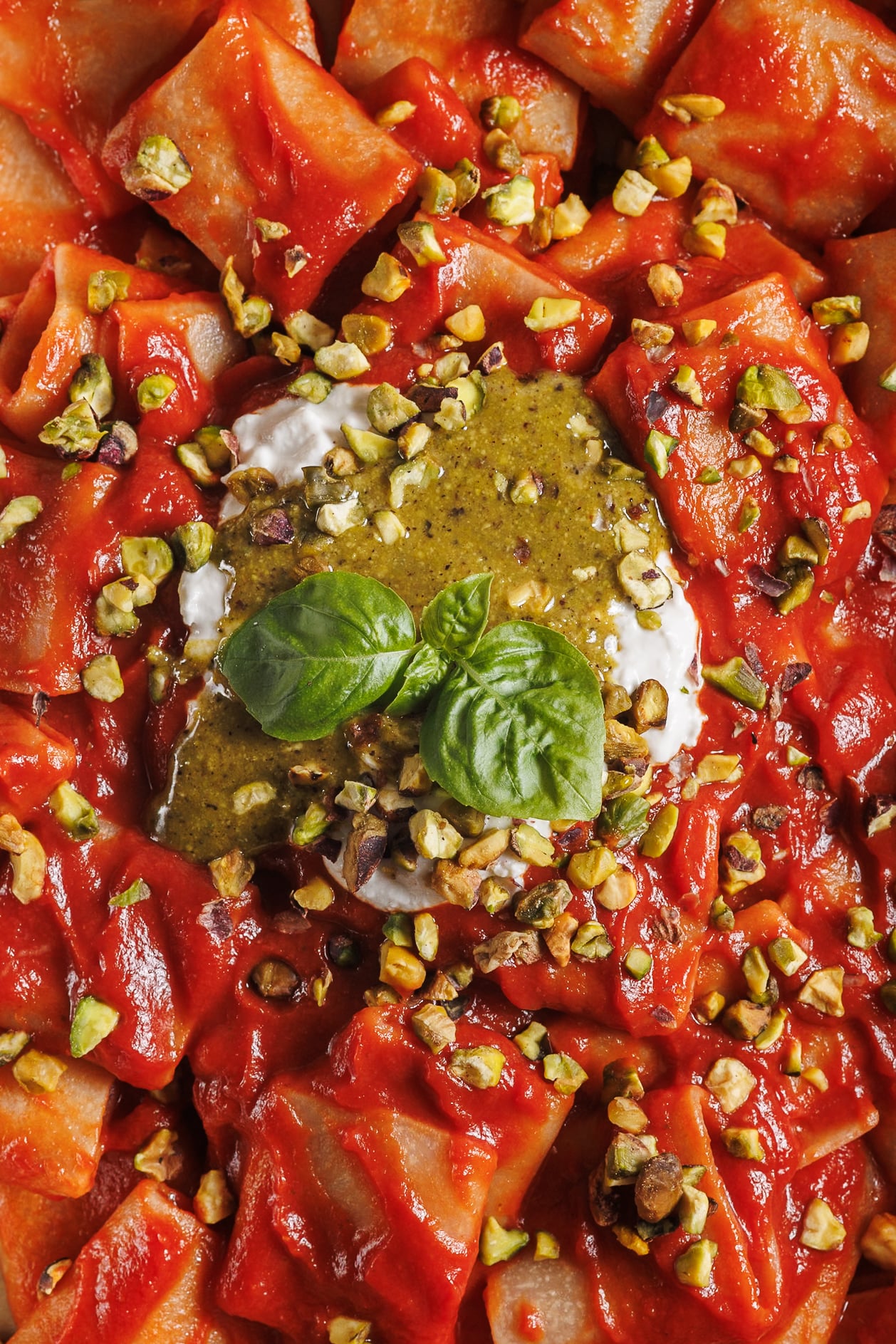
You don't fight the glycaemic peak by removing pasta. You manage it by deciding how it reaches the table.
What is the glycaemic index of pasta?
Di Pede 2021 (95 products, ISO protocol): refined wheat 55, wholemeal 52, egg 52, legumes 46. Sydney tables: spaghetti 47, penne 52, macaroni 63. ISS: spaghetti 49 vs bread 75, rice 73, potatoes 78.
Why pasta has a lower GI than bread and rice
Credit goes to pasta structure, not flour. Gluten traps starch; same-ingredient bread vs pasta trials show lower spikes; spaghetti AUC −41% vs bread (J Nutr 2022).
Wholemeal pasta and GI: the gap is smaller than you think
Wholemeal vs refined: ~3 GI points (52 vs 55); ranges overlap. Real wholemeal win: fibre 7.1 vs 1.7 g/100 g (CREA) — satiety and micronutrients, not the curve.
Shape matters more than flour
Long shapes beat short: spaghetti 47, penne 52, macaroni 63. Wolever 1986: 23-point gap, same semolina. Switching shape beats switching to wholemeal.
Al dente cooking: what studies really show
Al dente is good habit; same-experiment human trials (Wolever 1986, Bornet 1990) show no significant blood-glucose difference. In vitro effect exists; in vivo it's noise.
Cold and reheated pasta: here the effect is real — and large
Cooling forms resistant starch — large effect in T1D trial (AUC −~60%). Exploratory; EU claim needs resistant starch >14% of total starch.
What really lowers the meal's glycaemic response
Biggest lever: meal order (veg + protein before carbs, AUC −73.5% in pilot). Vinegar helps early; fat slows mash, not spaghetti. Legume pasta mean GI 46.
GI vs glycaemic load: the difference that changes decisions
GI = speed; glycaemic load = what happens on your plate. Watermelon high GI, low load; pasta opposite. Thresholds: low ≤55, medium 56–69, high ≥70.
Should you eat low-GI? What reviews say
Diabetes: low-GI diets help (HbA1c −0.31, BMJ 2021). Weight loss: ~0.82 kg, CI includes zero (Cochrane 2023). CREA: choosing foods by GI alone is misleading. EU health claims list doesn't include 'glycaemic index'.
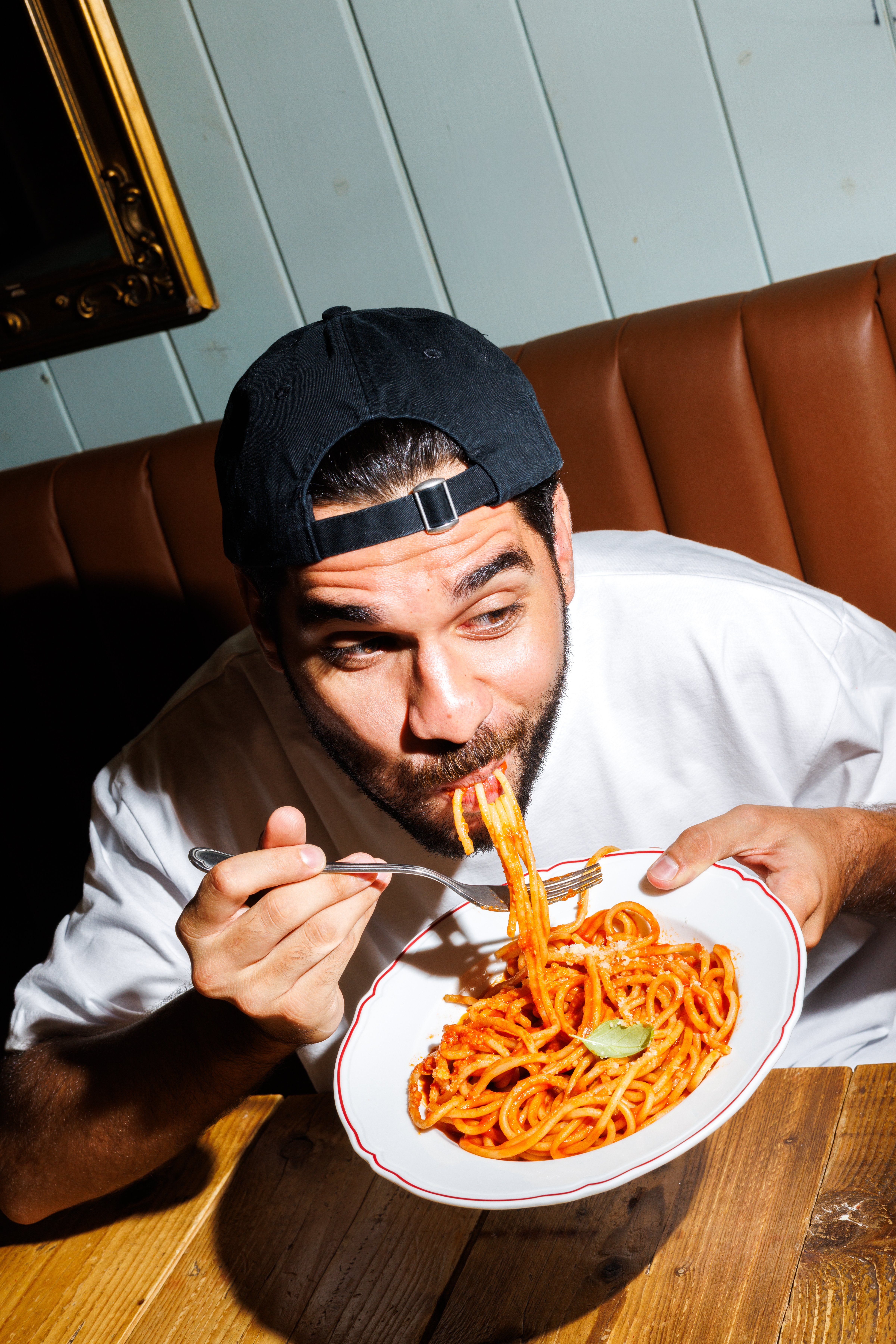
At miscusi, GI isn't a problem to fix
Long shape, al dente, veg/protein first — three free moves that beat miracle flour. Superpasta: organic Kronos + ancient grains + legume blends (lowest category mean). Menu or make your own.
Quick answers (FAQ)
What is pasta's glycaemic index?
47 (spaghetti) to 63 (short shapes), mean 52. Bread 75, rice 73 — pasta is the gentlest staple starch.
Which pasta has the lowest GI?
Legume pasta, mean 46, 78% low-GI. Among wheat-only, long thin shapes beat penne/macaroni by 16–23 points.
Does wholemeal pasta have lower GI?
Yes, but only ~3 points (52 vs 55). Real win is fibre 7.1 vs 1.7 g/100 g, not the curve.
How to lower pasta's GI?
Meal order (veg/protein first), long shape, legume pasta. Al dente is good habit; same-experiment human trials show little measurable difference.
Does cold pasta have lower GI?
Yes — among the largest documented effects via resistant starch after 24 h cooling, even when reheated. Exploratory single-pasta trial.
Why is pasta GI lower than bread?
Structure, not flour: gluten traps starch. Same-ingredient trials; spaghetti AUC −41% vs bread.
Do commercial low-GI pastas help?
EU health claims don't include 'glycaemic index'. Only specific ingredients with thresholds are allowed.
Sources
| 1. Di Pede G et al., Glycemic Index Values of Pasta Products: An Overview, Foods, 2021. https://www.mdpi.com/2304-8158/10/11/2541 |
| 2. Atkinson FS et al., International tables of glycemic index and glycemic load values 2021, Am J Clin Nutr, 2021. https://ajcn.nutrition.org/article/S0002-9165(22)00494-4/fulltext |
| 3. Istituto Superiore di Sanità, ISSalute, Indice glicemico. https://www.issalute.it/index.php/la-salute-dalla-a-alla-z-menu/i/indice-glicemico |
| 4. Zou W et al., Combined techniques for characterising pasta structure, Food Chemistry, 2015. https://pubmed.ncbi.nlm.nih.gov/26041231/ |
| 5. Granfeldt Y et al., Processing conditions, product thickness and egg addition in pasta, Eur J Clin Nutr, 1991. https://pubmed.ncbi.nlm.nih.gov/1782920/ |
| 6. Vanhatalo S et al., Pasta Structure Affects Postprandial Glucose Metabolism, J Nutr, 2022. https://pubmed.ncbi.nlm.nih.gov/34669959/ |
| 7. CREA, Tabelle di composizione degli alimenti, pasta integrale. https://www.alimentinutrizione.it/tabelle-nutrizionali/000850 |
| 8. Wolever TMS et al., Glycemic response to pasta, Diabetes Care, 1986. https://pubmed.ncbi.nlm.nih.gov/3743316/ |
| 9. Bornet FR et al., Pasta cooking time, Am J Clin Nutr, 1990. https://pubmed.ncbi.nlm.nih.gov/2178390/ |
| 10. Sissons M et al., Spaghetti Processing Variables and In Vitro Digestion of Starch, Foods, 2022. https://pubmed.ncbi.nlm.nih.gov/36429241/ |
| 11. Rogowicz-Frontczak A et al., Resistant Starch Formed by Cooling Pasta, Nutrients, 2026. https://www.mdpi.com/2072-6643/18/7/1152 |
| 12. Bojarczuk A et al., Cooking and Cooling Chickpea Pasta, Metabolites, 2024. https://www.mdpi.com/2218-1989/14/11/585 |
| 13. Regolamento (UE) n. 432/2012. https://eur-lex.europa.eu/legal-content/IT/TXT/HTML/?uri=CELEX:32012R0432 |
| 14. Shukla AP et al., Food Order Has a Significant Impact on Postprandial Glucose, Diabetes Care, 2015. https://europepmc.org/articles/PMC4876745 |
| 15. Östman E et al., Vinegar supplementation lowers glucose and insulin responses, Eur J Clin Nutr, 2005. https://pubmed.ncbi.nlm.nih.gov/16015276/ |
| 16. Gulliford MC et al., Differential effect of protein and fat ingestion on blood glucose responses, Am J Clin Nutr, 1989. https://pubmed.ncbi.nlm.nih.gov/2679037/ |
| 17. Chiavaroli L et al., Effect of low glycaemic index dietary patterns in diabetes, BMJ, 2021. https://europepmc.org/articles/PMC8336013 |
| 18. Chekima K et al., Low glycaemic index or load diets for people with overweight or obesity, Cochrane, 2023. https://europepmc.org/articles/PMC10313499 |
| 19. CREA, Linee guida per una sana alimentazione, 2018. https://www.crea.gov.it/documents/59764/0/LINEE-GUIDA+DEFINITIVO.pdf |