Spelt: from grain to goodness
At miscusi, durum wheat is our bread and butter, but we treat farro in the kitchen with the respect an older relative deserves: it has a few thousand years on us and is ageing beautifully.
In Italy, farro refers to three different types of wheat: einkorn, emmer and spelt. Emmer is the one you will most often find in shops. According to CREA, the research centre of Italy's Ministry of Agriculture, 100 grams of raw pearled farro, with almost all its outer layers removed, provide 69.3 grams of carbohydrates, 14.6 grams of protein and 6.5 grams of fibre, with little fat and good amounts of magnesium, phosphorus and potassium CREA [1]. It can be good for you as a cereal supplying fibre and minerals within a varied diet. It contains gluten, so people with coeliac disease cannot eat it.
Three different grains share one name and nobody seems to mind. One of them even earned a European protected geographical designation in Garfagnana back in 1996.
Einkorn, emmer and spelt: three grains under one name
All three are hulled wheat species: their kernels are enclosed in husks that remain attached after threshing and have to be removed in a separate process.
A 2007 survey of farro in Italy by Buerli for the international agricultural research network CGIAR sets out the three names and confirms that emmer is by far the most widely grown Buerli 2007 [2]. CREA's nutritional tables also mean emmer when they list farro CREA [1].
| Common name | Botanical name | Also known as | Worth knowing |
|---|---|---|---|
| Einkorn | Triticum monococcum | small farro | The oldest of the three, with a small, protein-rich kernel |
| Emmer | Triticum dicoccum | medium farro | The most widespread in Italy, including Garfagnana |
| Spelt | Triticum spelta | large farro | Closer to common wheat and widely used in Northern Europe |
Emmer also has a certificate that few cereals can boast. Farro della Garfagnana is a protected geographical indication (PGI), registered by the European Union in 1996 EU 1996 [3]. Its production specification—the document setting production rules—reserves the designation for Triticum dicoccum grain grown in certain municipalities in the province of Lucca PGI specification [4]. When you buy farro without further details, you are almost always buying emmer.
What's in farro: nutritional values
It mainly contains starch, a good share of protein, fibre and minerals, and very little fat.
CREA's figures refer to pearled farro, the most commonly sold form, both raw and boiled in water CREA [1] CREA [5]:
| Per 100 g | Raw pearled farro | Boiled pearled farro |
|---|---|---|
| Energy | 353 kcal | 178 kcal |
| Available carbohydrates | 69.3 g | 37.3 g |
| of which starch | 60.9 g | 33.1 g |
| Protein | 14.6 g | 6.2 g |
| Fat | 2.4 g | 1.0 g |
| Fibre | 6.5 g | 2.1 g |
| Magnesium | 112 mg | 23 mg |
| Phosphorus | 387 mg | 71 mg |
| Potassium | 407 mg | 50 mg |
| Iron | 1.9 mg | 0.6 mg |
CREA's reference serving is 80 grams of raw farro, which turns into a generously filled plate after cooking: it supplies around 55 grams of carbohydrates, almost 12 grams of protein and more than 5 grams of fibre. For athletes it is fuel for the day; for everyone else, it is still a meal that keeps you going until evening.
Mineral levels fall more than protein levels after cooking, probably because some minerals leach into the water. Use farro in soup and you get some of them back in the broth.
Is farro high in protein?
For a cereal, yes: 14.6 grams of protein per 100 grams raw. On its own, however, it doesn't quite complete the picture.
Farro proteins are low in lysine, one of the essential amino acids we must get from food. CREA gives this a number: its chemical score—a measure of how closely a protein matches a reference protein, with 100 as the maximum—is 68, with lysine as the limiting amino acid, meaning the one in shortest supply CREA [1].
Tuscan grandmothers already knew the answer without ever hearing of lysine: farro and beans in the same pot. Legumes provide the lysine the grain lacks, while the grain helps complement the legumes' amino-acid profile. Together, they make a more complete protein dish. Sometimes tradition gets there before the laboratory.
Of the three farro grains, einkorn is richest in protein. Gazza, Hidalgo and Brandolini, researchers at CREA, reported figures as high as 19–21% protein in the Journal of Cereal Science in 2023, including under organic cultivation Gazza 2023 [6]. It is also the least common type, so you need to look for it specifically.
What is farro good for? Benefits and evidence
Its main benefits come from fibre and minerals, which are also its best-studied components.
The evidence for fibre is strong. EFSA, the European Food Safety Authority, considers 25 grams of fibre per day an adequate intake for adults to support normal bowel function EFSA 2010 [7]. A serving of pearled farro provides more than 5 grams, one fifth of that daily amount on a single plate.
The evidence for benefits specific to farro is more nuanced. A key 2018 review of ancient wheats, including einkorn, emmer and spelt, by Dinu and colleagues at the University of Florence, published in the Journal of Nutritional Biochemistry, found favourable effects on cholesterol, blood glucose and inflammation in human studies. The authors called for further research before drawing definitive conclusions Dinu 2018 [8]. Science, like wholegrain farro, takes time to cook.
For the glycaemic index, the measure of how much a food raises blood glucose that we explain in our article on glycaemic index and glycaemic load, a 2021 review by Di Pede and colleagues in Foods collected measurements on emmer pasta: values ranged from about 18 to 56 depending on the variety and study Di Pede 2021 [9]. All are in the low or medium range, which includes pasta in general.
Einkorn has another distinctive feature: it is rich in lutein, the yellow pigment also found in egg yolks. Hidalgo and colleagues measured an average of 8.4 micrograms per gram across 54 different lines, or cultivated strains Hidalgo 2006 [10]. Farro is good for what it contains, no superpowers required.
Pearled, semi-pearled or wholegrain farro
What changes is how much of the grain's outer layer is removed. The more you take off, the less fibre remains and the faster it cooks.
Wholegrain farro retains the bran and outer layers; semi-pearled farro loses some of them; pearled farro loses almost all of them. That's why pearled farro generally cooks in around twenty minutes without soaking, while wholegrain farro needs longer and often a night in water. Pearled is for the busy cook; wholegrain is for someone who remembers to soak it the evening before. We've written a separate article on the numerical differences and how to choose among the three forms; the reasoning also applies to pasta and is covered in our article on wholewheat pasta.
Farro and gluten: why it isn't suitable for coeliacs
All three farro species contain gluten. People with coeliac disease cannot eat them.
The Italian Coeliac Association (AIC) lists farro, einkorn and spelt among prohibited cereals AIC [11]. For years there has been a claim that einkorn is tolerated, because some laboratory experiments produced encouraging results. Zanini and colleagues tested the claim in people, in a 2015 study in the European Journal of Nutrition: after 60 days of eating 100 grams of einkorn a day, coeliac patients showed intestinal damage and antibodies characteristic of the disease. The authors concluded that einkorn is not safe for people with coeliac disease Zanini 2015 [12]. That is also why our dishes containing farro are not suitable for people with coeliac disease.
Farro: contraindications and side effects
Apart from coeliac disease, there are few contraindications, mainly affecting people with sensitive intestines.
Farro contains fructans, sugars that the intestine cannot digest and that gut bacteria ferment, producing gas. In a 2022 review in Nutrition Bulletin, Brouns and colleagues note that many symptoms blamed on gluten disappear under medical testing and may instead be caused by fructans Brouns 2022 [13]. For people following a low-fructan diet on medical advice, Monash University offers useful information: traditionally made sourdough spelt bread is among the lowest-FODMAP products made with spelt Monash [14].
For everyone else, follow the fibre rule: if you're not used to it, start with small portions and give your gut time to adjust. A little bloating in the first few days is normal.
At miscusi, farro is on the plate and pasta takes centre stage
You came here to find out about farro's properties, and the answer is that it is a seriously good cereal: carbohydrates for energy, a respectable amount of protein for a grain, fibre and minerals. It has plenty to offer; we'll leave miracles to marketing labels.
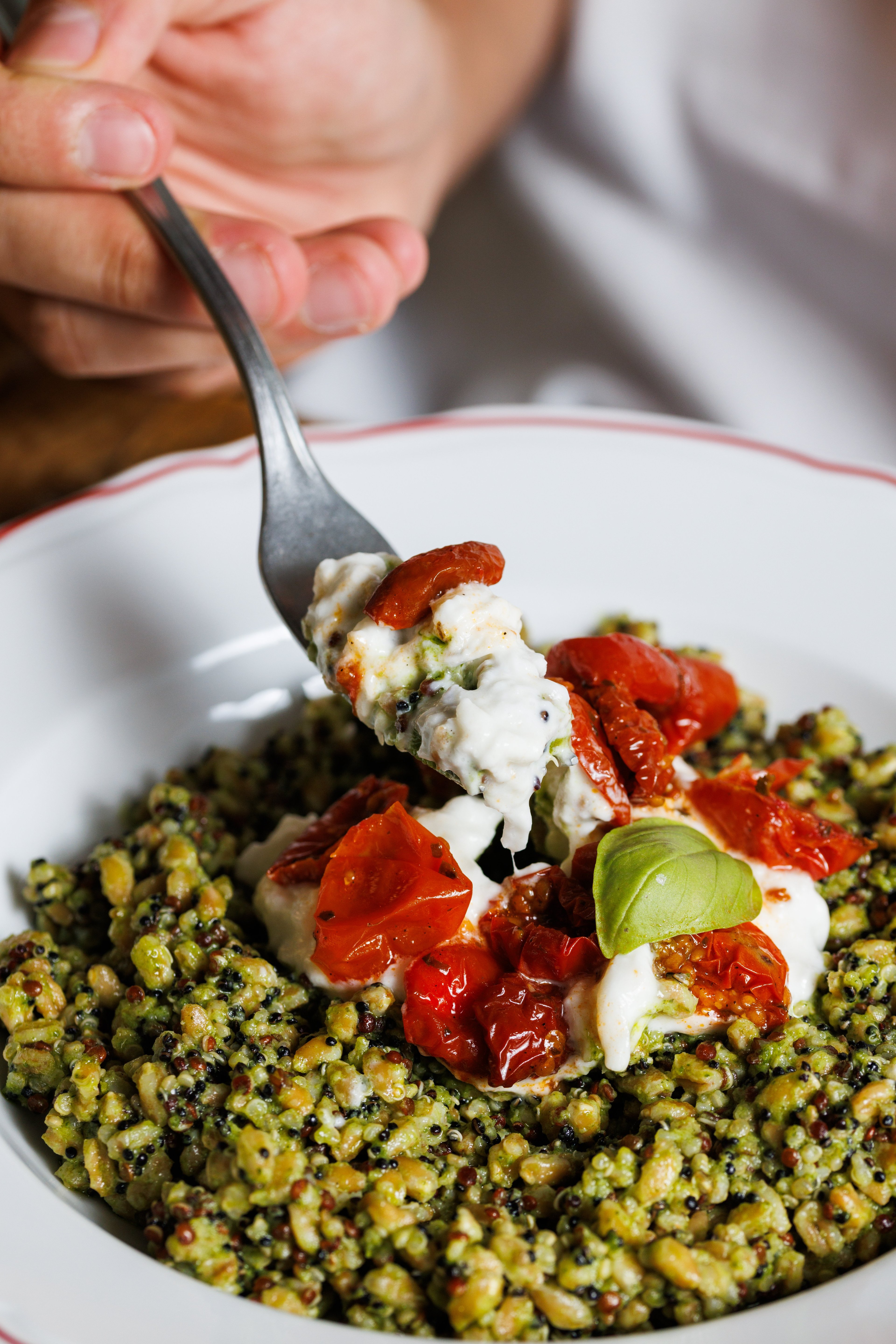
At miscusi you can find farro in our Riviera, where it shares the plate with quinoa, Genoese pesto, Apulian stracciatella and confit cherry tomatoes. Next to it is our Superpasta, fresh and made with water and organic semolina: Kronos durum wheat and stone-ground ancient grains such as Perciasacchi. Farro and durum wheat are relatives, but that's another story; at our table they get along just fine.
Choose a dish from our menu or go make your own, building a plate around what you need, whether you're preparing for a race or following a particular diet. Almost everyone can find something to eat at miscusi, even those who thought they were just coming in for a salad. Book your table.
Quick answers (FAQ)
Does farro make you gain weight?
No food makes you gain weight on its own. According to CREA, 100 grams of cooked pearled farro contain 178 calories, and its fibre can help you feel full. What matters is how much you eat overall throughout the day.
Does farro raise blood sugar?
Like any carbohydrate-rich food, it raises blood sugar, to a low or moderate degree: studies of emmer pasta measured glycaemic index values between about 18 and 56, depending on the variety. Eating it with vegetables, legumes or protein can further moderate the spike.
What's the difference between farro and spelt?
Spelt is one of the three types of farro, also called large farro. In Italy, when people say farro without further details, they usually mean emmer, or medium farro. All three contain gluten.
How much farro is one serving?
CREA's reference portion is 80 grams of raw farro, which becomes a generous plate after cooking. You would usually use less in a soup with legumes.
Is farro good for athletes?
Yes. It is high in carbohydrates and supplies a good amount of protein for a cereal, plus minerals such as magnesium. Before a race, pearled farro and a moderate portion may be better, since fibre slows digestion.
Is einkorn farro safe for coeliacs?
No. A 2015 clinical study of patients with coeliac disease who ate it for two months found intestinal damage and disease-related antibodies. The Italian Coeliac Association lists it among prohibited cereals, alongside emmer and spelt.
Sources
| 1. CREA, Food and Nutrition Research Centre, food composition tables, entry 000020, raw pearled farro. https://www.alimentinutrizione.it/tabelle-nutrizionali/000020 |
| 2. Buerli M, Farro in Italy: a desk-study, Global Facilitation Unit for Underutilized Species, CGIAR, 2007. https://cgspace.cgiar.org/bitstreams/e76cb8cb-bbed-43f1-b030-19d0439b1866/download |
| 3. Commission Regulation (EC) No 1263/96, registration of geographical indications, Farro della Garfagnana PGI, 1996. https://eur-lex.europa.eu/legal-content/IT/TXT/?uri=CELEX:31996R1263 |
| 4. Tuscany Region, Production specification for Farro della Garfagnana PGI. http://prodtrad.regione.toscana.it/dopigp_img/3_29.doc |
| 5. CREA, Food and Nutrition Research Centre, food composition tables, entry 000025, cooked pearled farro. https://www.alimentinutrizione.it/tabelle-nutrizionali/000025 |
| 6. Gazza L, Hidalgo A, Brandolini A, A high protein ancient wheat species: einkorn, Journal of Cereal Science, 2023. https://doi.org/10.1016/j.jcs.2023.103790 |
| 7. EFSA, Scientific opinion on dietary reference values for carbohydrates and dietary fibre, 2010 press release. https://www.efsa.europa.eu/en/press/news/nda100326 |
| 8. Dinu M, Whittaker A, Pagliai G, Benedettelli S, Sofi F, Ancient wheat species and human health: biochemical and clinical implications, Journal of Nutritional Biochemistry, 2018. https://doi.org/10.1016/j.jnutbio.2017.09.001 |
| 9. Di Pede G, Dodi R, Scarpa C, Brighenti F, Dall'Asta M, Scazzina F, Glycemic index values of pasta products: an overview, Foods, 2021. https://doi.org/10.3390/foods10112541 |
| 10. Hidalgo A, Brandolini A, Pompei C, Piscozzi R, Carotenoids and tocols of einkorn wheat (Triticum monococcum ssp. monococcum L.), Journal of Cereal Science, 2006. https://doi.org/10.1016/j.jcs.2006.06.002 |
| 11. AIC, Italian Coeliac Association, Prohibited cereals. https://www.celiachia.it/dieta-senza-glutine/gestire-dieta-senza-glutine/i-cereali-vietati/ |
| 12. Zanini B, Villanacci V, De Leo L, Lanzini A, Triticum monococcum in patients with celiac disease: a phase II open study on safety of prolonged daily administration, European Journal of Nutrition, 2015. https://doi.org/10.1007/s00394-015-0892-3 |
| 13. Brouns F, Geisslitz S, Guzman C et al., Do ancient wheats contain less gluten than modern bread wheat, in favour of better health?, Nutrition Bulletin, 2022. https://doi.org/10.1111/nbu.12551 |
| 14. Monash University FODMAP, Are all spelt products low in FODMAPs?, 2015. https://www.monashfodmap.com/blog/are-all-spelt-products-low-in-fodmaps/ |