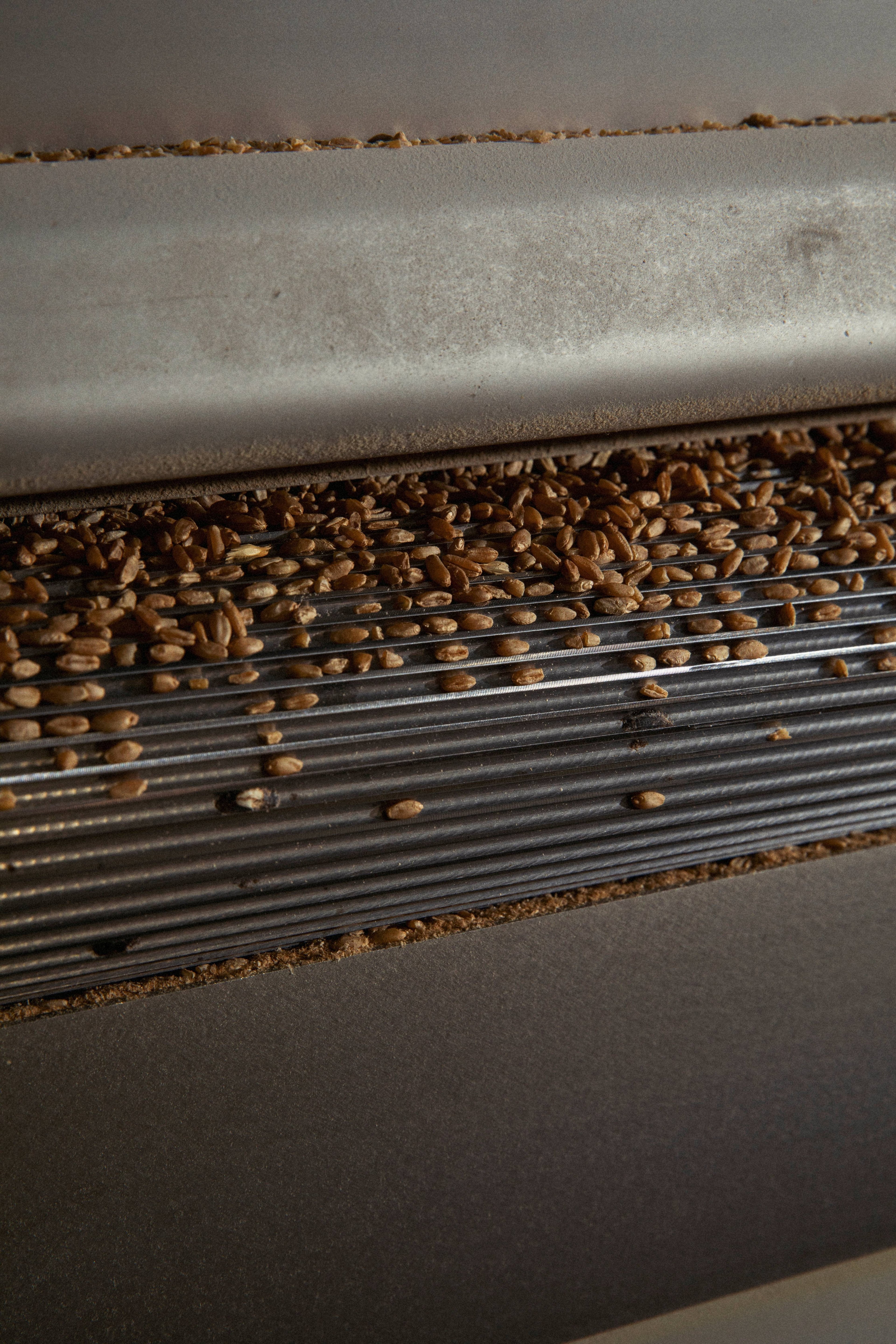
The whole grain, no doubt about it.
At miscusi we work with semolina every day, so we know the word wholegrain well: in Italy, it is more elastic than a well-made dough. Here you will learn to recognise the real thing and discover how little of it actually reaches our plates.
A grain is whole when all its parts remain together: bran, germ and endosperm in the same proportions as in the original kernel, even if it has been ground, cracked or rolled into flakes. The germ is the seed's embryo and the endosperm is the starch reserve that feeds it. True cereals are grasses, the botanical family of common and durum wheat, einkorn, emmer and spelt, barley, oats, rye, rice, maize, millet, sorghum, teff, a small Ethiopian grain, and triticale, a cross between wheat and rye. Quinoa, buckwheat and amaranth are treated as cereals for nutritional convenience, although botanically they are not.
The last time anyone counted, Italian adults ate an average of 3.8 grams of whole grains a day. A café sugar sachet weighs more.
What makes a grain whole
Keeping the kernel together. Remove the outer layer and the germ and you have a refined grain, even if you grind it finely again.
The definition most widely used in Europe was written by van der Kamp and colleagues for the HEALTHGRAIN working group in Food & Nutrition Research in 2014: a grain is whole if it is intact, ground, cracked or flaked, with the glumes removed — the husks that come off during threshing — provided that endosperm, germ and bran remain in the proportions of the intact kernel. Losses below 2% of the kernel or 10% of the bran are allowed van der Kamp 2014 [1].
The kernel has three parts with very different weights. According to Fardet's 2010 review in Nutrition Research Reviews, wheat endosperm accounts for 80–85% of the kernel, bran for 10–14% and germ for 2.5–3%, while fibre is concentrated where there is less weight: around 45% in the bran and 18% in the germ, compared with 13% in the whole kernel Fardet 2010 [2].
Refining comes at a high price: refined flour loses 58% of its fibre, 83% of its magnesium, 79% of its zinc, 92% of its selenium, 79% of its vitamin E and 61% of its folates, the B vitamins. Removing 15% of a kernel's weight means removing between half and nine tenths of the vitamins and minerals it contains.
Which grains are whole grains
They are grasses. Alongside them are three seeds that behave like cereals without actually being cereals.
| Botanical family | Species | Common name |
|---|---|---|
| Poaceae, true cereals | Triticum aestivum | common wheat |
| Poaceae | Triticum turgidum subsp. durum | durum wheat |
| Poaceae | Triticum monococcum | einkorn |
| Poaceae | Triticum turgidum subsp. dicoccum | emmer |
| Poaceae | Triticum spelta | spelt |
| Poaceae | Hordeum vulgare | barley |
| Poaceae | Avena sativa | oats |
| Poaceae | Secale cereale | rye |
| Poaceae | Oryza sativa | rice |
| Poaceae | Zea mays | maize |
| Poaceae | Sorghum bicolor | sorghum |
| Poaceae | Panicum, Eleusine, Pennisetum | millets |
| Poaceae | Eragrostis tef | teff |
| Poaceae | wheat and rye hybrid | triticale |
| Amaranthaceae, pseudocereals | Chenopodium quinoa | quinoa |
| Amaranthaceae | Amaranthus spp. | amaranth |
| Polygonaceae | Fagopyrum esculentum | buckwheat |
Pseudocereals do not belong to the grass family: quinoa and amaranth are Amaranthaceae and buckwheat is a Polygonaceae, as Atudorei and colleagues point out in a 2026 review in Foods Atudorei 2026 [3]. Buckwheat, for instance, has wheat only in its name. They are grouped with cereals because their nutritional profiles and uses are similar Whole Grains Council [4].
One name that sneaks into these lists is chia: it is an oilseed in the Lamiaceae family, and the reference definitions explicitly exclude oilseeds and pulses from whole grains, so flax, sunflower, soya and chickpeas are excluded too Whole Grains Council [4].
Naturally gluten-free cereals, usually the next question, are rice, maize, millet, sorghum and teff, plus the pseudocereals. Anyone diagnosed with coeliac disease must still check the labelling on flours and semolina, because processing can introduce gluten that was not in the grain. At miscusi, cooking also takes place in the same boilers as wheat pasta: this is why our dishes are not suitable for people with coeliac disease. We explain this in detail in our article on sorghum.
What Italian law says, and what it leaves unsaid
It says how much ash a flour must contain to be called wholemeal. It does not say how it must have been produced.
The reference legislation is Presidential Decree 187 of 2001, which defines milled cereal products using just two parameters: ash — the mineral residue left after burning a sample, which rises as more bran remains in the flour — and minimum protein content DPR 187/2001 [5].
| Common wheat flour | Minimum ash | Maximum ash | Minimum protein |
|---|---|---|---|
| Type 00 flour | not specified | 0.55 | 9.00 |
| Type 0 flour | not specified | 0.65 | 11.00 |
| Type 1 flour | not specified | 0.80 | 12.00 |
| Type 2 flour | not specified | 0.95 | 12.00 |
| Wholemeal flour | 1.30 | 1.70 | 12.00 |
For durum wheat, semolina is below 0.90 ash, semolato between 0.90 and 1.35, and wholemeal semolina between 1.40 and 1.80.
The decree does not define what wholegrain actually means: any milled product within that ash range can use the name, whatever route it has taken through the mill. Nor does any rule specify how much wholemeal flour bread or pasta must contain to use the word.
The European Union has no legal definition of wholegrain either, as the Commission's Joint Research Centre notes, and some countries have set their own thresholds: at least 50% wholegrain ingredients in Denmark and Sweden, 100% in the Netherlands European Commission [6].
A 2017 Chamber of Deputies dossier on a bill to define wholemeal flours and semolina, including those without germ, shows that the gap is known Chamber of Deputies 2017 [7]. If Parliament feels the need to define germ-free wholemeal, it means it is out there.
How to recognise a genuinely wholegrain product
Read the ingredients list. Colour proves nothing, and neither does a fibre claim.
The best source is CREA, the Agriculture Ministry's research centre, which puts it this way in its healthy eating guidelines:
"The label can help us: if it says 'with bran', the bran has been added, whereas if the ingredients specify, for example, wholemeal wheat flour or wholegrain oats, the product contains wholemeal flour."
Translated into three actions at the supermarket:
| 1. look for the word wholegrain or wholemeal next to a cereal in the ingredients list, such as "wholemeal wheat flour" or "wholemeal durum wheat semolina". If you find "wheat flour" plus "bran", the bran was added back afterwards; |
| 2. be wary of multigrain, with cereals and seven grains: those words merely count the cereals, and seven refined grains are still seven refined grains; |
| 3. dark colour is not proof, as it can come from added bran, malt or other ingredients. |
One detail, without alarm: the HEALTHGRAIN definition allows recombination, meaning flour produced by separating the kernel's parts in the mill and then putting them back together is wholegrain, provided the proportions are right Healthgrain Forum [9]. The process does not have to be stated on the label, however.
Why health bodies recommend them, and what the advice is based on
The recommendation comes from health institutions and rests on a broad body of epidemiological research. We cover both here, because understanding what dietary advice is based on makes it easier to follow.
What the health bodies recommend. In its healthy eating guidelines, CREA advises that at least half of the cereal portions eaten each day should be wholegrain, with adults consuming at least 25 grams of fibre a day CREA 2018 [8]. The same 25-gram threshold appears in the reference intake levels of the Italian Society of Human Nutrition SINU [15] and in the World Health Organization's 2023 guidelines, which classify it as a strong recommendation for adults and set lower thresholds for children WHO 2023 [16]. WHO also recommends that, from the age of two, carbohydrates should come mainly from whole grains, vegetables, fruit and pulses.
What those recommendations rest on. Large-scale population studies. The reference work is a meta-analysis — a study that pools results from several studies to estimate an overall effect — by Dagfinn Aune and colleagues, published in the British Medical Journal in 2016. It brought together 45 prospective studies involving between 316,000 and 705,000 participants, depending on the outcome examined Aune 2016 [10]. The series of reviews published in The Lancet in 2019 examined 185 prospective studies and 58 randomised controlled trials Reynolds 2019 [11], while the World Cancer Research Fund classified the available evidence on colorectal cancer WCRF 2018 [12]. Anyone who wants the detailed findings can read the papers linked above: they are all open access.
Two things that research says that rarely reach readers. The first concerns quantity: in Aune's work the association is observed up to around 210–225 grams a day, and does not increase beyond that amount, so the answer to "how much whole grain per day" has a measured ceiling. The second concerns strength: the Lancet series assessed the quality of evidence using GRADE, with certainty rated moderate for dietary fibre and low for whole grains as a category for three out of four outcomes. Put plainly, the best-documented link is with fibre.
One necessary clarification about what these figures mean. These are observational studies: they observe populations rather than assign diets. They show associations between eating habits and health, and an association is not proof of cause. Nothing written here is medical advice and nothing concerns a single food: it concerns a dietary pattern, which is the scale health bodies work on.
On weight, observational and randomised studies do not tell the same story
In population studies, people who eat whole grains weigh less. In experiments, making the switch does not lead to weight loss.
Sadeghi and colleagues say it in the title of their meta-analysis of randomised trials, published in Advances in Nutrition in 2020: wholegrain consumption does not affect measures of obesity Sadeghi 2020 [13]. The strongest finding concerns fibre, which reduced weight by 0.37 kilograms in controlled trials in the Lancet series, with high certainty Reynolds 2019 [11]. Less than 400 grams, or less than the packet of pasta in your cupboard.
Anyone promising weight loss from whole grains is promising more than the experiments can support. Health bodies recommend them for fibre and for the vitamins and minerals in the whole kernel.
If weight is your topic, we have covered it without shortcuts in does pasta make you gain weight? and does wholewheat pasta make you gain or lose weight?.
How much whole grain we eat in Italy
Very little. The figure is so low it looks like a misprint.
Sette and colleagues at the former INRAN, the food research institute now part of CREA, applied the HEALTHGRAIN definition to three-day food diaries from 2,830 adults and older people and 440 children and young people. Average consumption was 3.8 grams a day in adults, 3.3 in older people, 2.2 in adolescents and 2.0 in children, with just 23–24% of the sample eating any. Among adults, most came from bread Sette 2017 [14].
Then there is fibre: in Italy we consume an average of 17 grams a day, against the recommended 25 CREA 2018 [8].
We still have almost the whole journey to make between what we eat and half of our daily cereal portions. The survey dates from 2005–2006, so current consumption may be higher.
Pasta: wholewheat changes fibre more than blood sugar
Semolina pasta already has a low or medium glycaemic index — how quickly a food raises blood sugar — so switching to wholewheat changes the blood sugar curve very little.
In a 2021 review in Foods, Di Pede and colleagues collected the glycaemic index of 95 pastas: an average of 55 for refined wheat pasta and 52 for wholewheat, though the latter was based on just six samples Di Pede 2021 [17]. A Sicilian study of fourteen volunteers even found the opposite, with four artisanal wholewheat pastas above an industrial semolina pasta Pandolfo 2021 [18].
The reason lies in structure: in pasta, starch stays enclosed in a compact protein network, wholewheat or otherwise. Pasta, in other words, does not worry much about bran. Wholewheat pasta brings fibre, vitamins and minerals, while the blood sugar curve barely moves. We have a dedicated article on glycaemic index and load: glycaemic index and glycaemic load.
The real limitations, without alarm
Three, and none is a reason to go back to white.
Phytic acid. The kernel's outer layers contain a molecule that binds iron and zinc and reduces their absorption. Hurrell and colleagues measured this in thirty-nine adults using labelled iron, which can be tracked in the body: less than 1% was absorbed from the more wholegrain wheat, compared with 4.9–13.6% from the more refined wheat, and processes that break down phytic acid, such as bread fermentation, clearly improve absorption Hurrell 2002 [19]. The Istituto Superiore di Sanità, the technical body of Italy's National Health Service, lists it among the drawbacks of wholegrain foods Issalute [20].
Fructans, sugars that the intestine does not digest and that ferment in the colon, are more concentrated in bran than in flour, and bread fermentation breaks down 50–80% of them Struyf 2018 [21]. People with an irritable bowel may feel the effects of a rapid fibre increase, so it is best to increase it gradually.
Contaminants, such as mycotoxins produced by moulds and heavy metals, are also concentrated in the outer layers: in durum wheat fractions richer in bran, one of these mycotoxins was 74–150% higher Cammerata 2022 [22]. None of the sources we read, however, documents a health risk from whole grains consumed within legal limits.
At miscusi, fibre is in the pasta shape you choose
You came here to find out which grains are whole grains: they are grasses with the entire kernel, plus three pseudocereals that have gatecrashed the party. But the more useful question is how much of them you eat.
At our restaurants you find fibre by looking at the pasta shape, and we share the numbers. The dish on our menu with the most fibre is Fusilloni, with 8.2 grams per portion (miscusi data [23]), around a third of what an adult should consume in a whole day. Fusilloni, Spaghetti, Tagliatelle, Paccheri and Rigatoni qualify for the European source of fibre claim: with the Italian average stuck at 17 grams a day, that is a meaningful contribution.
Superpasta is fresh, egg-free and made with water and organic semolina from Kronos durum wheat and stone-ground ancient grains such as Perciasacchi. If you are interested in the raw ingredients, we tell their story here and in our article on ancient grains.
Choose a dish from the menu or make your own, choosing your pasta shape, sauce and protein source one by one. Runners, people watching their diet, plant-based eaters: almost everyone can eat at miscusi. Book your table and ask which pasta shape has the most fibre.
Quick answers (FAQ)
Which grains are whole grains?
They are cereals with the entire kernel: common wheat, durum wheat, einkorn, emmer and spelt, barley, oats, rye, rice, maize, sorghum, millets, teff and triticale. Quinoa, amaranth and buckwheat are grouped with them, but botanically they are pseudocereals.
Which whole grains come as kernels?
Those bought and cooked whole: brown rice, hulled barley, wholegrain spelt, oats, rye, millet, sorghum and, among pseudocereals, buckwheat and quinoa. White rice and pearl barley have lost bran and germ, so they do not count as whole grains.
Which whole grains are best?
There is no official ranking, and none in the sources we read. CREA and World Health Organization recommendations refer to whole grains as a category, so it makes sense to vary them: barley, oats, spelt, brown rice, rye and others. What makes the difference is whether the kernel is truly whole, which you check in the ingredients list.
What is the difference between whole and refined grains?
Whole grains retain bran, germ and endosperm in the kernel's original proportions; refined grains retain almost only endosperm, and refining removes 58% of fibre, 83% of magnesium and 79% of vitamin E.
Which grains are refined grains?
Grains with their bran and germ removed, meaning non-whole grains: common wheat flour types 00, 0, 1 and 2, durum wheat semolina, white rice, refined maize semolina and products made from them, from white bread to semolina pasta.
How can you tell whether a product is truly wholegrain?
Look for wholegrain or wholemeal next to the cereal in the ingredients list. According to CREA, "with bran" means added bran, while a dark colour or a fibre claim does not prove that a product comes from the entire kernel.
Which foods are wholegrain foods?
All foods made with cereals using the entire kernel: wholemeal bread and pasta, oat flakes, brown rice, wholegrain rusks and crackers, barley and spelt kernels. To identify them, check the ingredients list, where wholegrain or wholemeal must appear next to the cereal, as in "wholemeal wheat flour".
Do whole grains help you lose weight?
In population studies, people who eat more weigh less, while in controlled trials replacing refined grains with whole grains does not change measures of obesity. The strongest finding concerns fibre and amounts to 0.37 kilograms. Health bodies recommend them for fibre, vitamins and minerals.
Sources
| 1. van der Kamp JW, Poutanen K, Seal CJ, Richardson DP, The HEALTHGRAIN definition of whole grain, Food & Nutrition Research, 2014. https://foodandnutritionresearch.net/index.php/fnr/article/view/676 |
| 2. Fardet A, New hypotheses for the health-protective mechanisms of whole-grain cereals: what is beyond fibre?, Nutrition Research Reviews, 2010. https://www.cambridge.org/core/journals/nutrition-research-reviews/article/new-hypotheses-for-the-healthprotective-mechanisms-of-wholegrain-cereals-what-is-beyond-fibre/CADD660D4B3EADC44D58DDA91C78D30D |
| 3. Atudorei O, Atudorei D, Codină GG, Pseudocereals in bakery products: a review of nutritional composition, health benefits and bakery applications, Foods, 2026. https://www.mdpi.com/2304-8158/15/8/1283 |
| 4. Whole Grains Council, Definition of whole grain. https://wholegrainscouncil.org/definition-whole-grain |
| 5. Presidential Decree no. 187 of 9 February 2001, Regulation revising the rules on the production and marketing of milled cereal products and pasta, Articles 1 and 2. https://www.normattiva.it/eli/id/2001/05/22/001G0242/CONSOLIDATED |
| 6. European Commission, Joint Research Centre, Health Promotion Knowledge Gateway, Whole grain. https://knowledge4policy.ec.europa.eu/health-promotion-knowledge-gateway/whole-grain_en |
| 7. Chamber of Deputies, Research Service, dossier on the labelling of unrefined or whole durum wheat flours, A.C. T.U. 1932, 2017. https://documenti.camera.it/leg17/dossier/pdf/cost.309.pdf |
| 8. CREA, Guidelines for healthy eating, 2018 revision, guideline 3 More whole grains and pulses. https://sapermangiare.an.crea.gov.it/files/download/linee-guida/linee-guida-03.pdf |
| 9. Healthgrain Forum, Whole grain definition. https://healthgrain.org/whole-grain/ |
| 10. Aune D, Keum N, Giovannucci E et al., Whole grain consumption and risk of cardiovascular disease, cancer, and all cause and cause specific mortality: systematic review and dose-response meta-analysis of prospective studies, BMJ, 2016. https://www.bmj.com/content/353/bmj.i2716 |
| 11. Reynolds A, Mann J, Cummings J, Winter N, Mete E, Te Morenga L, Carbohydrate quality and human health: a series of systematic reviews and meta-analyses, Lancet, 2019. https://pubmed.ncbi.nlm.nih.gov/30638909/ |
| 12. World Cancer Research Fund and American Institute for Cancer Research, Diet, nutrition, physical activity and colorectal cancer, Continuous Update Project, 2018. https://www.wcrf.org/wp-content/uploads/2024/10/Colorectal-cancer-report.pdf |
| 13. Sadeghi O, Sadeghian M, Rahmani S et al., Whole-grain consumption does not affect obesity measures: an updated systematic review and meta-analysis of randomized clinical trials, Advances in Nutrition, 2020. https://doi.org/10.1093/advances/nmz076 |
| 14. Sette S, D'Addezio L, Piccinelli R et al., Intakes of whole grain in an Italian sample of children, adolescents and adults, European Journal of Nutrition, 2017. https://link.springer.com/article/10.1007/s00394-015-1097-5 |
| 15. SINU, Italian Society of Human Nutrition, LARN, carbohydrates and dietary fibre. https://sinu.it/2019/07/09/carboidrati-e-fibra-alimentare/ |
| 16. World Health Organization, Carbohydrate intake for adults and children: WHO guideline, 2023. https://www.ncbi.nlm.nih.gov/books/NBK594788/ |
| 17. Di Pede G, Dodi R, Scarpa C, Brighenti F, Dall'Asta M, Scazzina F, Glycemic index values of pasta products: an overview, Foods, 2021. https://pmc.ncbi.nlm.nih.gov/articles/PMC8623826/ |
| 18. Pandolfo A, Messina B, Russo G, Evaluation of glycemic index of six different samples of commercial and experimental pasta differing in wheat varieties and production processes, Foods, 2021. https://www.mdpi.com/2304-8158/10/9/2221 |
| 19. Hurrell RF, Reddy MB, Burri J, Cook JD, Phytate degradation determines the effect of industrial processing and home cooking on iron absorption from cereal-based foods, British Journal of Nutrition, 2002. https://www.cambridge.org/core/journals/british-journal-of-nutrition/article/phytate-degradation-determines-the-effect-of-industrial-processing-and-home-cooking-on-iron-absorption-from-cerealbased-foods/AE626805F550CF44DFEF27316F9D2ECE |
| 20. Istituto Superiore di Sanità, Wholegrain foods, Issalute, 2022. https://www.issalute.it/index.php/la-salute-dalla-a-alla-z-menu/a/alimenti-integrali |
| 21. Struyf N, Verspreet J, Courtin CM, FODMAP reduction in yeast-leavened whole wheat bread, Cereal Foods World, 2018. https://www.cerealsgrains.org/publications/plexus/cfw/pastissues/2018/protectedpdfs/CFW-63-4-0152.pdf |
| 22. Cammerata A, Marabottini R, Del Frate V et al., Use of air-classification technology to manage mycotoxin and arsenic contaminations in durum wheat-derived products, Foods, 2022. https://doaj.org/article/991dc4a288e54f27ac5e5cb5c691bb6a |
| 23. miscusi, internal nutritional analysis of the menu, 2026 |